Know what you have
Is this shedding, or is it something else?
Three things get mistaken for each other, and they need very different next steps. See which one sounds like you.
Shedding
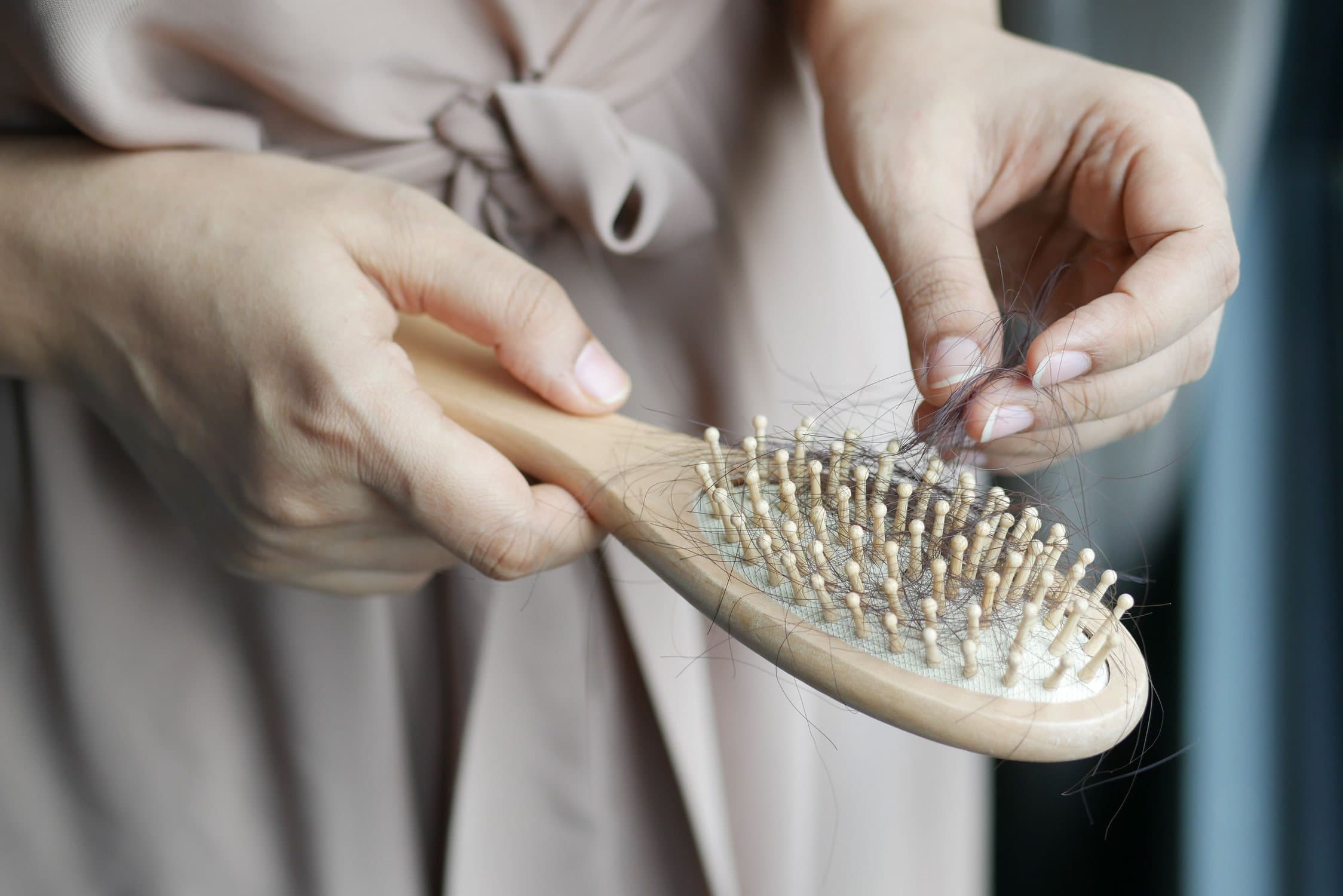
It started fairly suddenly, in the last few weeks or months. Hair is coming out from all over your head, not one spot. You're losing noticeably more than usual in the shower, the brush and on the pillow. If you look at a hair that's come out, it's full length with a tiny white bulb at the root.
Pattern hair loss
It's been slow, over a year or more, and you can't say when it started. Your parting is wider than it used to be, or your temples and crown have thinned, but you're not losing handfuls. The hair seems finer and shorter rather than falling out in volume. If this is you, the assessment is the right next step, because this is the type of hair loss where treatment actually helps.
Something a doctor should see
Smooth, round, completely bald patches. A scalp that's sore, itchy, scaly, blistered or looks scarred. A hairline that's receding while your eyebrows thin too. None of these is shedding. Skip to the section on when to see your GP, and do that first.
Shedding or breakage? The bulb test
Here's a test hair specialists use that hardly anyone outside a clinic knows about. Take a few of the hairs from your brush or the plughole and look at the ends.
- A shed hair is as long as the rest of your hair and has a tiny white or clear bulb at one end. That bulb is the root. The hair finished its cycle and let go. This is shedding.
- A broken hair is shorter than the rest, has no bulb, and often looks frayed or split at one end. It didn't fall out, it snapped. Breakage comes from bleach, heat, tight styles, extensions and rough handling. It gets better when the cause of damage stops.
Some people think they're shedding, but they're actually breaking hair, while others may have been told by a salon that their hair is "damaged", but they're actually shedding. Knowing what you have changes everything that follows, so do this before you do anything else.
Your hair isn't damaged, and your shampoo didn't do this
Shedding is not caused by hard water, sulphates, silicones, washing too often, washing too little, or the wrong conditioner. Almost nothing you put on your hair makes the roots let go of it, and switching shampoo won't stop it. If your hair has a bulb, your hair isn't damaged, and the answer isn't in a new shampoo or conditioner.
How shedding works
What telogen effluvium actually is
Every hair on your head is at one of three stages. Most are growing, which lasts years. Some have stopped growing and are resting, which lasts a few months. And a few are being shed to make room for new hair in the same follicle. Normally about one hair in ten is resting at any time, which is why losing 50 to 100 hairs a day is completely normal.
When something gives your body a shock, it puts hair growth on hold and pushes a much bigger share of hairs into the resting phase at once. Hair isn't essential, so it's one of the first things your body stops spending energy on. Nothing visible happens for two to four months. Then all those resting hairs let go together, and it looks like your hair is falling out.
The delay is the clue almost everyone misses. You're shedding today because of something that happened to you months ago. Once you know that, the cause is usually obvious, and it's why the Bristol Hair Loss Clinic assessment asks when your shedding started.
Common triggers
What sets it off
These are the triggers we see most often, in men and women. Think back two to four months from when the shedding started.
Illness, fever and infection
Any illness with a high temperature, including flu and Covid, can trigger a shed roughly three months later, when you've long since felt better and forgotten about it.
Having a baby
Pregnancy hormones hold hair in its growing phase, which is why hair often looks its best when you're pregnant. A few months after the birth all of the hairs that were retained are released. It peaks around three to four months and usually settles by the baby's first birthday. If it hasn't, or your parting is wider than before you were pregnant, read our guide to female hair loss, because pregnancy can also reveal pattern thinning that was quietly there.
Crash diets, rapid weight loss and weight loss injections
Losing weight fast, whether through a strict diet, surgery or medicines like Mounjaro and Wegovy, is a common shedding trigger right now. It's thought to be the speed of the weight loss and the drop in protein and nutrients that do it, not the medicine itself.
Operations and general anaesthetics
Surgery is a shock to the body, and shedding two to four months after an operation is common and expected. The good news is it passes.
Big stress and grief
Real, sustained stress, a bereavement, a divorce, a redundancy, can trigger a shed. It's real, but it's also the explanation people get given when nobody has looked properly. If "stress" is the answer you've been handed and nothing in your life fits, or the shedding is going on and on, don't settle for it. The Bristol Hair Loss Clinic assessment can help you work out what else might be going on.
Starting, stopping or changing medicines
Hormonal contraception, some antidepressants, blood thinners, some acne treatments and some blood pressure medicines can all trigger a shed when you start, stop or switch. It usually settles as your body adjusts. Never stop a medicine because of your hair without talking to whoever prescribed it first.
Low iron and thyroid problems
These two are different from everything above. Every other trigger passes on its own, and the hair recovers once it has. Low iron stores and an underactive or overactive thyroid don't correct on their own, and the hair won't fully recover until they're sorted. They're also the two causes hair loss treatments can't work around, so minoxidil is less effective while either is still there. That's why, for some people, a blood test through their Bristol GP surgery or a home test kit is the most useful next step.
Wegovy and Mounjaro hair loss
If you're on Mounjaro or Wegovy and your hair has started coming out, you're not alone. Hair shedding is a recognised side effect of rapid weight loss on these injections, and plenty of people are quietly wondering whether to stop because of it. Please don't, at least not for this reason, and not without talking to whoever prescribed them.
Hair loss is thought to work the way other sheds do when experiencing rapid weight loss and eating a lot less. Your body responds the way it always does to a shock - it puts hair growth on hold for a while. The shedding usually starts a few months into treatment and settles as your weight stabilises and your eating steadies, whether or not you're still on the medicine.
What helps is eating enough protein every day, even when you're not hungry, and checking your iron with a blood test if you've been eating very little for months. If your weight is coming off very fast, ask your prescriber whether a slower pace would suit you. Stopping the injections often means the weight comes back, and it won't stop a shed that's already started.
What to expect
How long does hair shedding last?
Telogen effluvium usually lasts three to six months from when it starts. It slows down before it stops, which means the last month or so feels like nothing is changing even though it is. That's the point where some people feel demotivated, but it's the point where they're nearly through.

Regrowth is happening underneath the whole time. Every hair that let go left a follicle behind, and that follicle has already started a new hair. You won't see them for a while because they're short and tapered, but they're there.
Once the shedding stops, it takes another six to twelve months for your hair to look as thick as it did, because the new hairs need time to grow long enough to add volume. So a full recovery is often a year or more from the original trigger.
If the trigger that set it off has passed and you're still shedding heavily beyond six months, or your parting is wider now than it was before the shed, that's when to stop waiting and take our hair loss assessment.
The good sign that looks like a bad one
A few months into recovery, a lot of people panic all over again, and it's because of the regrowth itself. The new hair is odd-looking. You get fuzz at the hairline that won't lie flat. Short "antenna" hairs sticking straight up at the crown. Flyaways everywhere, and a parting that looks fluffy rather than smooth.
People read these as breakage, or as damage, or as the hair getting worse. Some cut them off. Please don't do this! This is the good news arriving. Those are the hairs that will make your hair look thick again once they've had a year or more to catch up with the rest. Leave them alone, let them grow.
Testing
The blood test that matters
Most shedding doesn't need a blood test at all. If you had a baby four months ago, or you've lost two stones recently, you already know the cause, and the plan should be to wait it out.
But some people should test, and for them it's the most useful next step. You should take a test if you can't name a trigger, or if the shedding is dragging on past six months. And test if any of these apply to you - heavy periods, a vegetarian or vegan diet, a known thyroid condition, months of eating very little, or feeling tired, cold, foggy or low alongside the hair loss. Those are the signs that iron or thyroid might be part of the story, and those are the two things that won't fix themselves.
Two results matter. Ferritin, which measures the iron your body has stored. And thyroid function. Vitamin D is often checked at the same time. There's one thing to know before you look at your results - the lab's "normal" range for ferritin starts very low, because it was set to answer "has this person run out of iron?" rather than "is there enough iron here to grow hair well?" Most hair specialists want to see ferritin comfortably above the bottom of the range before they'd rule iron out. If you have a result, keep the actual number, not just the word "normal".
There are two ways to do this:
1. Ask your Bristol GP surgery
Say something like "My hair started shedding heavily about X months ago, and I'd like my ferritin and thyroid function checked." Ask for the numbers when the results come back, not just whether they were normal.
2. Order a home test
If you'd rather not wait for an appointment, you can get a hair loss blood test that covers ferritin, thyroid function and vitamin D. It costs £85, arrives as a finger-prick kit, and you get your results online with a doctor's report.
Stop biotin before your blood test
This one surprises people. The high doses of biotin found in hair gummies and hair, skin and nails supplements can interfere with the way labs measure thyroid hormones and produce falsely abnormal results. If you've been taking them, stop at least three days before your test, or you may end up thinking you have a thyroid problem you don't have.
Also, ferritin reads falsely high when you've recently been ill or have any inflammation going on, so test once you're properly well, not in the middle of the infection that caused the shed. And some supplements can cause shedding at high doses, particularly vitamin A and selenium, so if you've been taking a supplement stack of them for your hair, they may be part of the problem rather than the answer. It's unlikely people selling supplements will tell you this.
Men - a shed is not the start of going bald
Men shed too, after a bad flu, a fast weight loss, an operation or a hard year. A lot of men in that moment go straight to a finasteride subscription for a shed that would have stopped by itself within a few months, and then credit the tablet for the recovery.
Here's how to tell the difference. A shed comes from all over your head, starts fairly suddenly, and settles within months. Male pattern baldness recedes at the temples and thins at the crown, creeps in over years, and doesn't settle. If your hairline and crown look the same as they did in a photo from two years ago, this is a shed. Wait for it to pass.
If they don't look the same - if the temples have gone back or the crown is showing through under bright light, that's a different conversation, and one where treatment does genuinely help, especially early. Take the assessment to see what's right for you.
The relapse fear
Once you've been through one shed, you live braced for the next. Every wash day is a test. So, honestly, yes, shedding can come back. The next bad illness, the next baby, the next rapid weight loss can each trigger another one, and chronic telogen effluvium can come and go over time.
But each shed doesn't leave you permanently thinner. Telogen effluvium doesn't destroy follicles. The same follicle regrows a new hair every time. The only way repeated sheds leave you with visibly less hair is if there's pattern hair loss underneath doing the real work, which is why one proper look is worth more than a lifetime of bracing. And the second shed after a baby or an illness is far less frightening than the first, because this time you've watched one end.
When to see a doctor
When shedding needs a GP first
Shedding on its own is not a medical emergency and doesn't need urgent attention. But your hair is sometimes the most visible sign of something else that does. Visit your GP in Bristol soon if, alongside the hair loss, you're losing weight without trying, you feel persistently unwell, exhausted or cold, your periods have changed or stopped, or you've noticed other new symptoms. In that situation the hair is the least important thing that pattern is telling you, and a blood test through your GP is the right first step rather than a home kit.
A patchy loss, a sore or inflamed scalp, or hairline and eyebrow thinning in women should be seen by a GP first. Those aren't shedding, they can need a dermatologist, and some of them are time-sensitive. If the assessment spots any of these, it won't offer you anything except a clear list of what to say and ask at your appointment. For more information, learn about scalp conditions and treatments.
Hair shedding FAQs
Around 50 to 100 hairs a day, more on wash days because you're collecting several days' worth at once. Most people never notice this until they start looking. If it's clearly more than that, from all over, for more than a few weeks, that's shedding.
Clumps in the shower are almost always telogen effluvium - lots of hairs reaching the end of their resting phase together and coming out in one go when you wash. It looks dramatic because they've all been loose for a while. If the "clumps" are leaving smooth bald patches behind, that's different, and that requires a GP appointment.
Yes, but it takes a lot more than a bad week. Sustained, serious stress or a major life event can trigger a shed two to four months later. Everyday stress doesn't. If you've been told it's stress and nothing in your life fits, take our hair loss assessment.
Because that's what minoxidil does first. It shortens the resting phase, so hairs that were already on their way out let go sooner, usually in the first two to eight weeks of treatment. It looks like the shedding is getting worse, but it's the old hairs being cleared out so new, thicker ones can grow in behind them. It's normal, and it's temporary. Keep going. Most people see the shed settle by month three and new growth from around month four. If it hasn't settled by then, or your scalp is sore or irritated, speak to your prescriber rather than stopping on your own.
Because that's exactly when a shed arrives. The illness pushed a large share of your hair into its resting phase, and two to four months later it all let go. Post-Covid shedding is very common, settles like any other shed, and grows back.
Yes. The follicles aren't damaged, they're resting. Shedding stops within about six months, and your hair begins to look as thick as it did within six to twelve months after that. If it doesn't, something else is likely going on, and that's the time to take the Bristol Hair Loss Clinic assessment.
Indirectly, yes. It's thought to be the fast weight loss and reduced eating that trigger the shed, rather than the medicine acting directly on your hair. It usually settles as your weight steadies. Don't stop the treatment because of your hair without talking to your prescriber. Slowing the rate of weight loss and eating enough protein can help.
Only if a blood test shows your ferritin is low. Iron does nothing for your hair if you weren't short of it, it often upsets your stomach, and too much is harmful. Test first, through your Bristol GP or a home test kit.
Shedding that carries on, or keeps coming back, for more than six months without a clear fresh trigger. It's most common in women aged roughly 30 to 60, it isn't dangerous and it doesn't cause baldness. It's worth a proper look, because it can hide an iron or thyroid problem or turn out to be pattern hair loss.
No. Shedding itself doesn't damage follicles. What can happen is that a shed uncovers pattern hair loss that was already there, and that does progress if it's left alone. If your parting is wider after a shed than it was before, that's the thing to check.
For ordinary shedding, no. If you have bald patches, a sore or scaly scalp, or a receding hairline with thinning eyebrows, you need a GP and possibly a dermatologist, and you shouldn't wait. If your shedding won't settle or your parting has changed, our assessment will tell you whether it's worth a clinician's opinion.
A trichologist is a hair and scalp specialist rather than a medical doctor. They can be useful if you'd like your scalp examined in person, if your hair seems to be breaking rather than shedding, or if you want hands-on hair care and advice while a shed settles. We've explained what a Bristol trichologist does, what it typically costs and when a visit is worth it.
About the author

Kate Holohan
RIT · Cert Ed · Registered Trichologist
Kate Holohan is a registered trichologist and the founder of Hair Therapy UK, an award-winning trichology clinic in Kings Hill, Kent. She has worked with hair and scalps for more than 30 years, first in hairdressing and education. She then trained in trichology with the Institute of Trichologists.
Kate diagnoses and treats hair loss and scalp conditions in adults and children. Her work covers female pattern thinning, shedding, alopecia, hair loss linked to hormones, menopause, thyroid and medication, and scalp conditions such as psoriasis and seborrhoeic dermatitis. She also supports people with medical hair loss from cancer treatment and surgery. She hosts the Hair Therapy podcast, which has more than 200 episodes on hair health and real patient stories. Kate has spoken at the World Trichology Conference.
Her approach starts with a careful consultation to understand what is driving the hair loss before recommending a plan. She works with a wide referral network that includes dermatologists, prescribers and blood-testing services, so people get to the right specialist.
- Professional registration
- RIT (Institute of Trichologists, Registrant)
Medically reviewed
This page was last medically reviewed by Kate Holohan on .

Kate Holohan
RIT · Cert Ed · Registered Trichologist
Bristol Hair Loss Clinic is committed to providing clear, accurate and evidence-based information about hair loss, hair thinning, scalp conditions and their treatment.
Our content is reviewed at least every 12 months to reflect current UK clinical guidance. All treatment pathways described on this website are subject to individual clinical assessment and review.
Read our editorial policy to see how our content is written, reviewed and kept up to date.
